Most riders can describe what an ideal posture roughly looks like think sitting upright, toes pointing forward, and heels down. But it is just as important to understand why these elements of posture are so crucial.
Without a clear explanation, riders often develop their own (and sometimes incorrect) interpretation, causing the posture to lose its function.
A good posture is functional: it supports you in moving with the horse, giving subtle aids, and staying balanced during different exercises and gaits.
Position and stirrup lenght
Position
Regardless of the type of saddle you use, a correct riding position and adjusting the proper stirrup length always start with assuming the right position in the saddle. You should sit in the deepest part of the saddle, with an upright and balanced posture. The so-called “ear-shoulder-hip-ankle” line forms the foundation: when viewed from the side, these points should align vertically. This provides stability, balance, and an independent seat.
In addition, the position of the pelvis is crucial. With a neutral pelvis, the rider can better follow the horse’s movements without tension or disruption.
The stirrup should be positioned under the ball of the foot, allowing for adequate shock absorption and even weight distribution while riding.
This functional posture helps the rider to ride effectively and in balance.
Stirrup lenght
The correct stirrup length is not exactly the same for every rider or every saddle, but it is essential for a stable and independent seat.
Once you have assumed the basic position, as described earlier, you also need to consider the placement of the knee roll. The shape and angle of the knee roll can vary between saddles: on one saddle it may be steeper, on another more upright or positioned further forward.
The thigh should lie relaxed along the saddle and fit neatly against the knee roll.
Note:
The thigh should not lie over the knee roll (too short stirrups or incorrect leg position), but there should also not be a large gap between the thigh and the knee roll (too long stirrups or insufficient support).
The correct stirrup length is always a balance between your body structure and the type of saddle. What feels perfect in one saddle may not feel right in another. Always take these differences into account and adjust where necessary.
Alignment
When a rider sits exactly above their own center of gravity, you can draw an imaginary line from ear-shoulder-hip to ankle. Sitting over your center of gravity creates stability. Your body then has to work much less to stay balanced. I like to ask my riders: “If your horse suddenly stepped out from under you, would you stay upright or fall?” The answer often reveals a lot about how well you are balanced.
For example, if you are in a chair seat, with your legs pushed too far forward, your center of gravity falls behind your base of support, making it easier to lose balance. In such a position, your muscles must constantly compensate, which leads to tension, fatigue, and less control.
Give it a try:
First, sit all the way back in your chair, with your back firmly against the backrest. Now try to stand up without leaning your upper body forward first. You’ll notice that this is almost impossible. This is because, in this position, you are sitting behind your center of gravity. Your body has no balance and no line of force to rise straight up, which means you automatically have to move forward before you can stand.
Now sit on the edge of the chair. Place your feet slightly underneath you so that your sit bones are positioned above your base of support. Now try to stand up. This will likely be much easier and require almost no effort. Because you are now sitting over your center of gravity, your body is immediately balanced, allowing you to rise without compensation or extra force.
This difference clearly shows how important it is to position yourself above your center of gravity. When you do, your body moves efficiently and lightly. But when you sit too far behind it, every movement becomes heavier and more unstable.
Symmetrie
You want your weight to be evenly distributed over both sit bones. Ideally, your shoulders should be level, and the same goes for your hips. Your spine should always remain perpendicular to the horse’s, which means you never “lean” with the horse’s movement. Instead of bending, you maintain an upright posture, allowing your spine to rotate freely without collapsing.
Feel it for yourself:
Sit on your hands on a chair, wiggle and gently twist back and forth, and notice how the weight shifts on your sit bones.
Always check whether you are truly centered in the saddle.
Even if it looks like you are sitting straight, you can unconsciously be slightly shifted to one side. You may notice this if you feel that the stirrups seem uneven, even though they are technically adjusted the same. This is often a sign that your body weight is not evenly distributed or that you are not centered in the saddle.
Other signs include the saddle consistently shifting to one side or your horse taking bend more easily on one side. When you are not properly centered, it creates an uneven distribution of pressure on the horse’s back, which can lead to asymmetry, tension, or overload.
Head
Your head quickly weighs 4–6 kilograms. As soon as you tilt it, that weight shifts immediately to one side. This forces your torso to compensate, creating tension and asymmetry in your seat. It works the same way as holding a weight close to your body or away from it: the further it moves out of alignment, the more muscle strength is needed to maintain your balance. By keeping your head directly above your torso, your body remains well-supported, stable, and relaxed.
A common example of this can be seen in riders who look along the side of the horse during a turn or circle. They tilt their head, and unconsciously their shoulders and upper body follow. This often causes asymmetry and disrupts an independent seat and aids.
Core stability
When you adopt an active, upright posture, your torso opens up. This not only creates space to tilt the pelvis correctly but also allows for better breathing. Instead of thinking “chest forward,” it’s better to use a visual image, such as: “Imagine a string attached to the crown of your head gently pulling you upward.” This helps you lengthen your upper body without creating tension.
The natural curves of the spine play an important role in this: a slight rounding in the upper back and a natural hollow in the lower back provide resilience and balance. These curves are slightly different for each rider, and that is perfectly normal.
Pelvis
It is important to understand how your pelvis affects your posture and how well you can follow your horse’s movement. Many riders unknowingly tilt too far forward or backward, which can throw them off balance or cause them to lock into the saddle.
When you tilt your pelvis forward, your lower back arches. When you tilt it backward, your lower back rounds. The ideal position is exactly in between: the neutral pelvis. The natural curvature of the spine varies slightly for each rider, but what is essential is that your sit bones point straight down, so your pelvis is in a neutral position. This forms the foundation for a stable and functional seat, allowing you to follow the horse smoothly.
A good way to feel this is through conscious practice:
First, tilt your pelvis fully forward and notice how your lower back arches. Then tilt your pelvis fully backward and feel how your lower back rounds. Next, find the middle: your pelvis is neutral, your sit bones point straight down, and your back feels stable yet relaxed.
By practicing this regularly, you will learn to find your neutral pelvis more easily while riding, improving your balance and effectiveness in the saddle.
Arms
It is important that your hands remain still relative to the horse. When your hands stay steady, you move with the horse’s mouth, which is essential for smooth and calm rein contact. This means your shoulders stay relaxed and your elbows “open and close” as they follow the horse’s movements, keeping the contact supple and functional. Your arms act like a gate through which your body moves, allowing you to follow the horse’s natural motion without tension or blockage.
Your balance and core stability directly affect the relaxation of your arms. Just as you instinctively use your arms to regain balance on the ground when you lose your equilibrium, a stable core also influences how relaxed and responsive your arms and hands can remain while riding. By keeping your core strong and stable, your arms can follow the horse rather than compensating with tension.
Hands
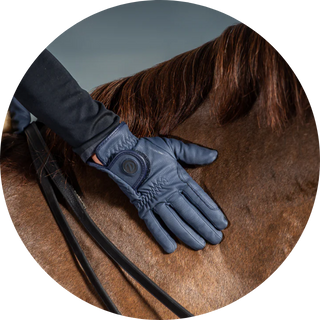
A straight line from the elbow to the horse’s mouth is essential for a good connection. Biomechanically, this line is strongest and most relaxed when your hands are carried upright, with the thumbs as the highest point. In this position, the radius and ulna—the two bones in the forearm—lie parallel to each other. This allows the muscles in the forearm to stay relaxed, keeping the arm “open” and responsive.
As soon as you rotate your hands flat, these bones cross over each other, creating tension in the forearm and shoulder. This directly affects the rein contact: it becomes tight, inelastic, or even disruptive to the horse.
In short:
✅ Thumbs up = relaxed forearms, functional elbow movement, soft hands.
❌ Flat hands = tense muscles, blocked movement, disruptive contact.
So, focus not only on where your hands are but especially on how you carry them. A small adjustment in hand position can make a big difference in your communication with your horse.
Legs
It is important to understand that a correct leg position does not start at the foot or knee, but at the hip joint. How the thigh is rotated in the hip determines how the rest of the leg behaves in relation to the horse and the saddle.
When the legs are rotated outward from the hip, several problems arise:
- The rider sits more on the rounded back of the thigh and calf, causing the leg to “roll away” more easily.
- The leg slides forward, which results in the rider sitting behind the horse’s center of gravity.
- This unstable position makes the leg restless, which hinders the use of subtle, functional aids.
Therefore, we aim for a leg position in which:
- The thighs lie against the saddle with the flat inner side.
- The knees maintain light contact and the toes point forward, not outward.
- This creates a large base of support, leading to greater stability and quieter aids.
- The knees and ankles can absorb movement.
This leg position requires a certain degree of hip mobility, which can vary greatly between riders. Some riders naturally have more room to rotate their thighs inward, while others (for example, due to tension or anatomical limitations) find this position more challenging.
Feet
The placement of the foot in the stirrup has a direct impact on balance, stability, and shock absorption. With the stirrups positioned under the ball of the foot—the widest part, just behind the toes—you have the largest base of support and the best ability to stay balanced and absorb the horse’s movement.
When you extend the foot too far (up to the instep), ankle flexion becomes impossible. The same applies when the stirrup sits under the tips of the toes and the heel is strongly pushed down; the ankle is then fully extended and lacks shock absorption.
A fun way to feel the importance of stirrup placement is to stand on a small stool or the edge of a step:
- first with only your toes on the edge
- then with the ball of your foot
Where do you feel more balanced and in control? This direct experience helps you understand the difference and why it is important for the stirrups to be correctly positioned under the foot.
To effectively absorb movement in walk, trot, and canter, both mobility and stability in the ankles are required. How flexible and stable a rider is in the ankles varies per individual and depends on factors such as body structure, posture, muscle length, and training experience.
Boost your riding position and seat!
Transform your riding position an seat in just 6 weeks!
The 10 basics are the first foundational steps toward a functional riding posture. In the online training Boost Your Riding Posture & Seat!, we go deeper into:
- Developing a functional posture through clear videos and practical exercises, both on the ground and in the saddle
- Moving with your horse in the basic gaits, so sitting trot or canter is no longer a challenge
- Sitting correctly in every lateral movement, so you can ride them successfully every time
- Specific exercises that help your development progress in big leaps