Why is bending important?
If your horse does not bend correctly, you can notice it from a few signs:
- He falls onto the inside shoulder
- He drifts out over the outside shoulder
- The hindquarters swing to the outside
- He leans into the turn instead of bending
- He steps less actively under with the hind legs, causing him to fall more on the forehand
- The contact becomes unsteady
- The tempo becomes rushed or irregular
- Lateral movements become more difficult to perform
These are all signs that the balance and bending are not yet optimal.
You can have flexion without bend, but you cannot have bend without flexion.
Flexion
Flexion is the lateral movement in the neck, just behind your horse’s ears.
You ask for flexion by gently turning your horse’s head slightly in the direction of the turn with your inside hand, so that you can just see the inside nostril. If you see more than that, your horse is often overbent.
Your inside hand stays soft and moves slightly away from the neck rather than pulling back toward you. Support this with your inside leg at the girth. At the same time, a supporting outside rein ensures that your horse does not bend too much and stays balanced.
Correct flexion is the foundation for good bend throughout the whole body.
Bend
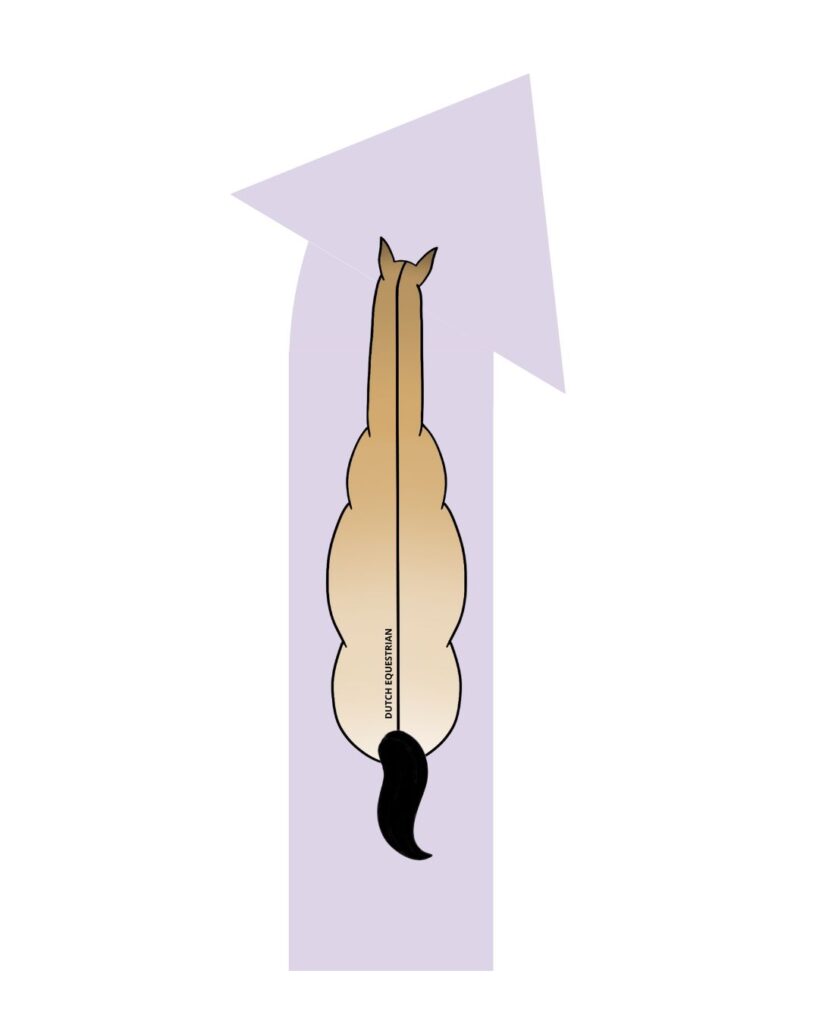
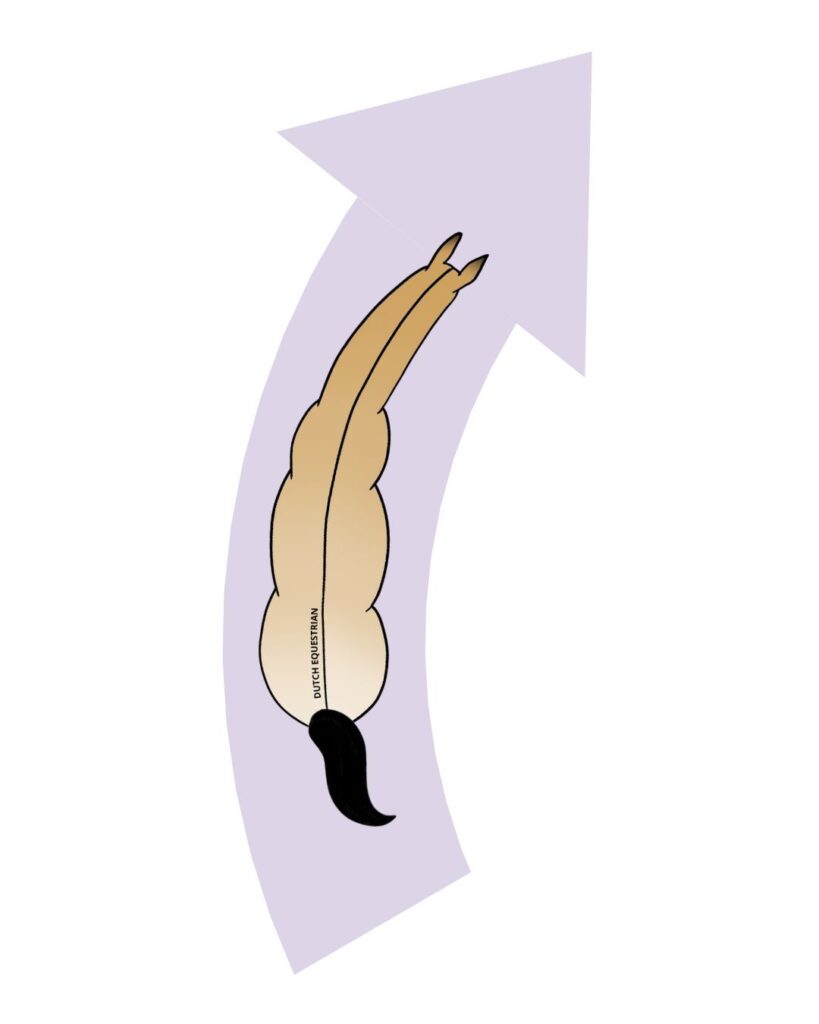
With correct bend, your horse’s spine follows the line of the turn you are riding. If you were to look at your horse from above, you would see that his body follows the curved line of the turn.
On a circle, this means that the smaller the circle, the more bend is required from the horse. The horse must then adjust its body more to follow the curved line.
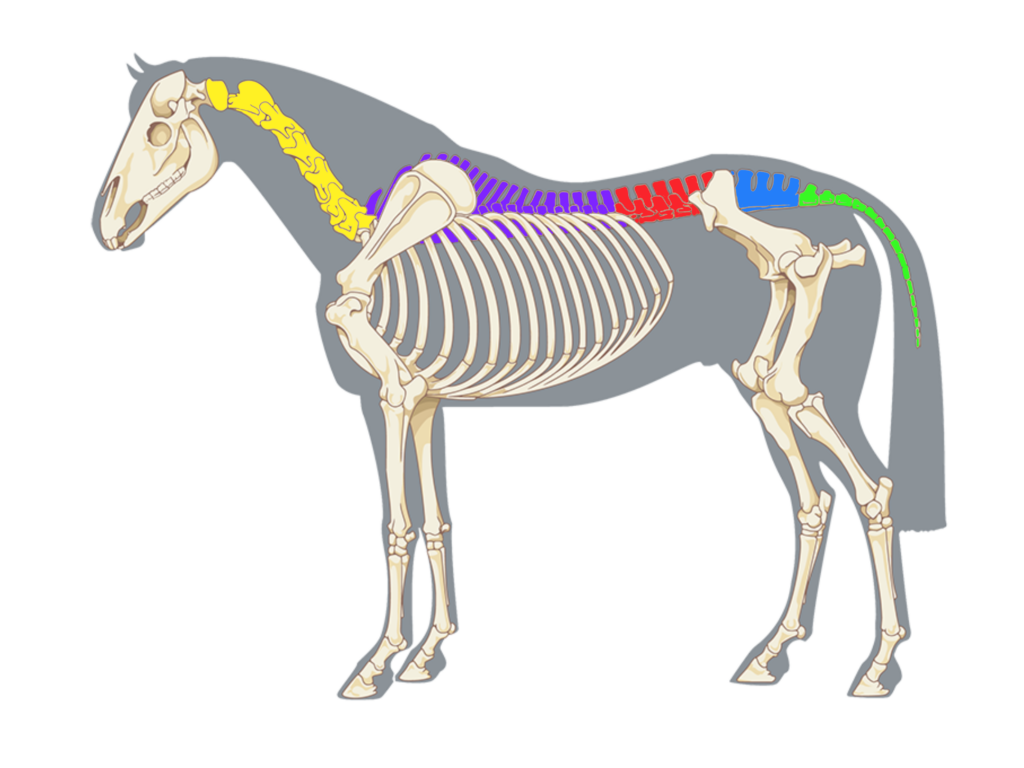
Longitudinal bend is the bending of your horse’s spine to the left or to the right. It is important to know that a horse cannot bend equally throughout the entire spine. Some parts are very mobile, while others have much more limited movement.
The different parts of the spine each play their own role in this:
- The 7 cervical vertebrae (yellow) have a lot of freedom of movement and can bend relatively easily to the left and right.
- The 18 thoracic vertebrae (purple) are connected to the ribs. Because of this, the bend here is more limited; too much bending would cause the ribs to press against each other.
- The 6 lumbar vertebrae (red) have large lateral projections, which also limits lateral (sideways) bending in this area.
- The sacrum (blue), which consists of 5 fused vertebrae, cannot bend.
- The 18 tail vertebrae (green) can move, but they do not contribute to the longitudinal bend of the body.
The most important aids
Inside leg at the girth
The inside leg asks your horse to bend through its body. It encourages your horse to shorten the inside of the body and lengthen the outside.
Your inside leg also creates forward impulsion, allowing the inside hind leg to step further underneath the horse’s center of gravity.
Outside leg behind the girth
The outside leg guards the hindquarters of your horse and prevents them from swinging out.
Inside rein asks for flexion
The inside rein indicates the direction of the bend and helps position your horse’s neck along the curved line.
The inside rein is not used to steer your horse. Doing so causes too much neck bend and makes your horse fall onto the outside shoulder.
Outside rein controls the outside shoulder
The outside rein helps prevent the neck from bending too much and gives you control of the outside shoulder so the horse does not fall outward.
The outside rein also helps regulate the tempo (rhythm). The outside rein “guides” the forehand inward.
Look in the direction you are riding
Keep your head up and look in the direction you are riding.
Weight distribution
Keep slightly more weight on your inside seat bone while staying upright. Do not lean inward.
By having slightly more weight on the inside seat bone, it becomes easier for the horse to lengthen the outside of its body and step more under with the inside hind leg.
Shoulders follow the shoulders of your horse
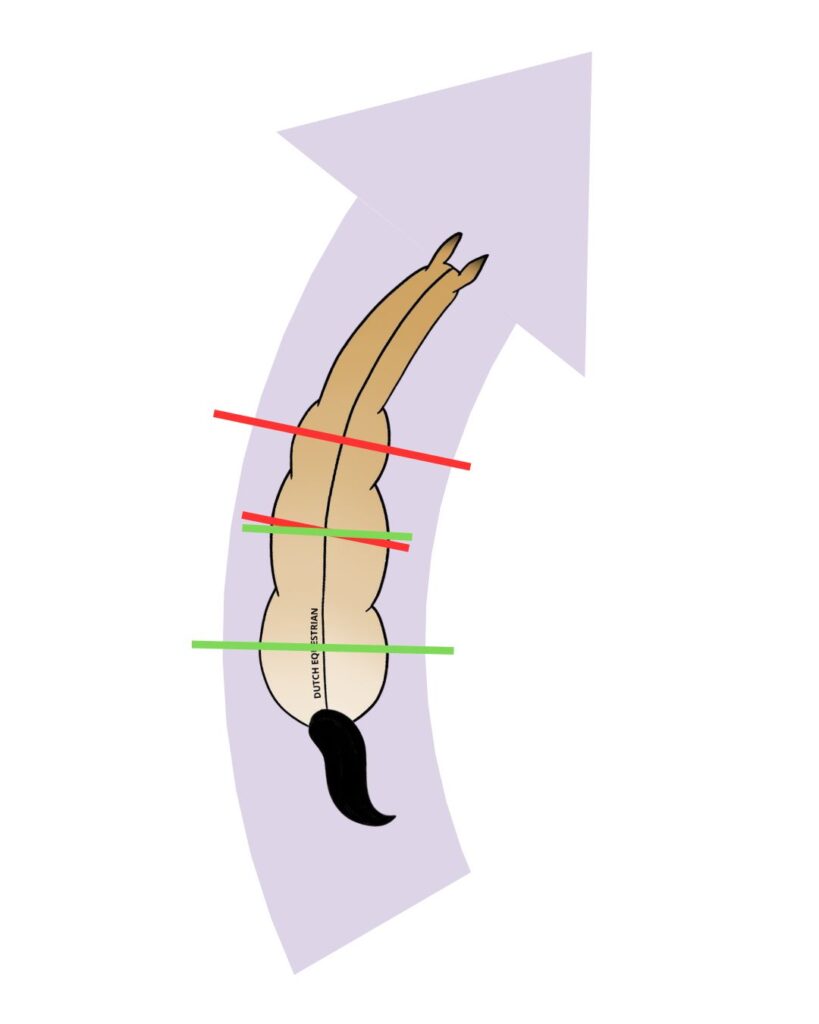
Turn your shoulders slightly inward from your waist so they align with your horse’s shoulders (red lines). Make sure you do not bend your upper body.
Hips follow the hips of your horse
The rider’s inside hip remains slightly open so that it aligns with the horse’s hip (green lines).
Correct bend improves balance, suppleness, and control on circles, in corners, and in turns, and over time helps your horse develop greater lateral suppleness.
Boost your riding position and seat!
Transform your riding position an seat in just 6 weeks!
The 10 basics are the first foundational steps toward a functional riding posture. In the online training Boost Your Riding Posture & Seat!, we go deeper into:
- Developing a functional posture through clear videos and practical exercises, both on the ground and in the saddle
- Moving with your horse in the basic gaits, so sitting trot or canter is no longer a challenge
- Sitting correctly in every lateral movement, so you can ride them successfully every time
- Specific exercises that help your development progress in big leaps