
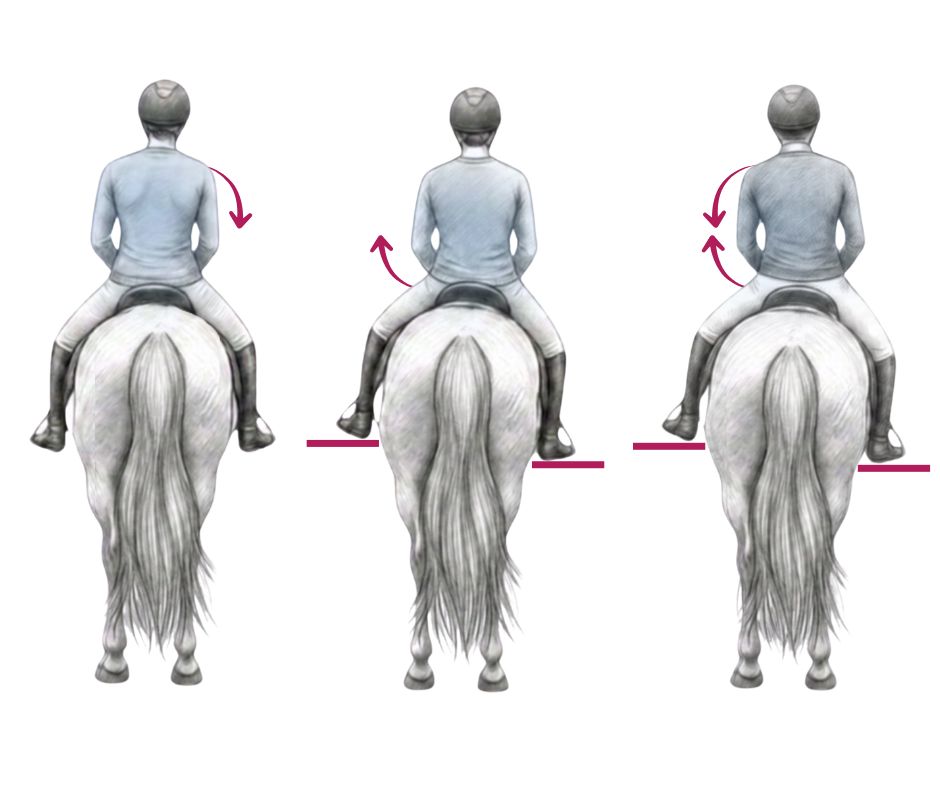
You try to sit straight, but your instructor keeps telling you that you’re crooked.
You correct yourself. You consciously sit taller. Maybe you pull one shoulder back or try to put more weight into one stirrup.
Yet, after a few minutes, it happens again.
You’re sitting crooked.
Many riders believe that sitting crooked is simply a matter of paying more attention. In reality, it is rarely a conscious mistake. More often, it is your body’s way of compensating for an underlying imbalance.
A small asymmetry in your position can have a surprisingly large effect on the way your horse moves.
Perhaps your horse bends more easily to one side. One rein always feels heavier than the other. Or maybe one stirrup constantly feels longer, even though you’re certain they’re adjusted equally.
Most riders assume the problem lies with the horse.
But very often, it starts with the rider.
Do you recognise any of these signs?
- Your instructor regularly tells you that you’re sitting crooked.
- One stirrup always feels longer than the other.
- One hip feels higher or further forward.
- Your horse bends more easily in one direction.
- You find yourself leaning into circles without noticing.
- One shoulder always seems to drop lower than the other.
- When you watch photos or videos of yourself riding, you don’t appear centred over your horse.
If you recognise several of these points, there’s a good chance that your crooked seat isn’t the real problem, it’s a symptom of something else.
And that’s exactly why simply trying to “sit straighter” rarely solves it.
Why “just sitting straight” usually doesn’t work
Most riders try to correct a crooked position by forcing themselves upright. They lift one shoulder, shift their weight or consciously try to sit evenly.
It sounds logical.
But in most cases, you’re only correcting the visible symptom, not the underlying cause.
When your body develops a compensation pattern, it happens automatically. As long as that compensation remains, your body will naturally return to the same crooked position, no matter how often you correct yourself.
To truly improve your position, you first need to understand why you’re sitting crooked.
But that’s just the beginning
As a Premium Member, you’ll also receive unlimited access to the entire Knowledge Library, featuring in-depth articles on rider biomechanics, dressage, jumping, horse biomechanics and training.
New Premium articles are added every two weeks, so your library continues to grow with inspiring, riding-explained content.
Become a Premium Member today for just €4,95 per month and gain unlimited access to every Premium article, now and in the future.
Continue reading with Premium
This article continues in the Knowledge Library.
As a Premium Member, you’ll unlock this complete article, including:
✔ Why riders sit crooked even when they’re trying to sit straight.
✔ The most common biomechanical causes of a crooked seat.
✔ How your position directly affects your horse’s balance and straightness.
✔ A simple exercise to identify whether the imbalance comes from your torso or your pelvis.
✔ The most common mistake riders make when trying to correct a crooked seat.
✔ Practical tips to help you develop a more balanced, symmetrical position in the saddle.
